
YouTube Promote and Monetization: What Counts Before You Pay
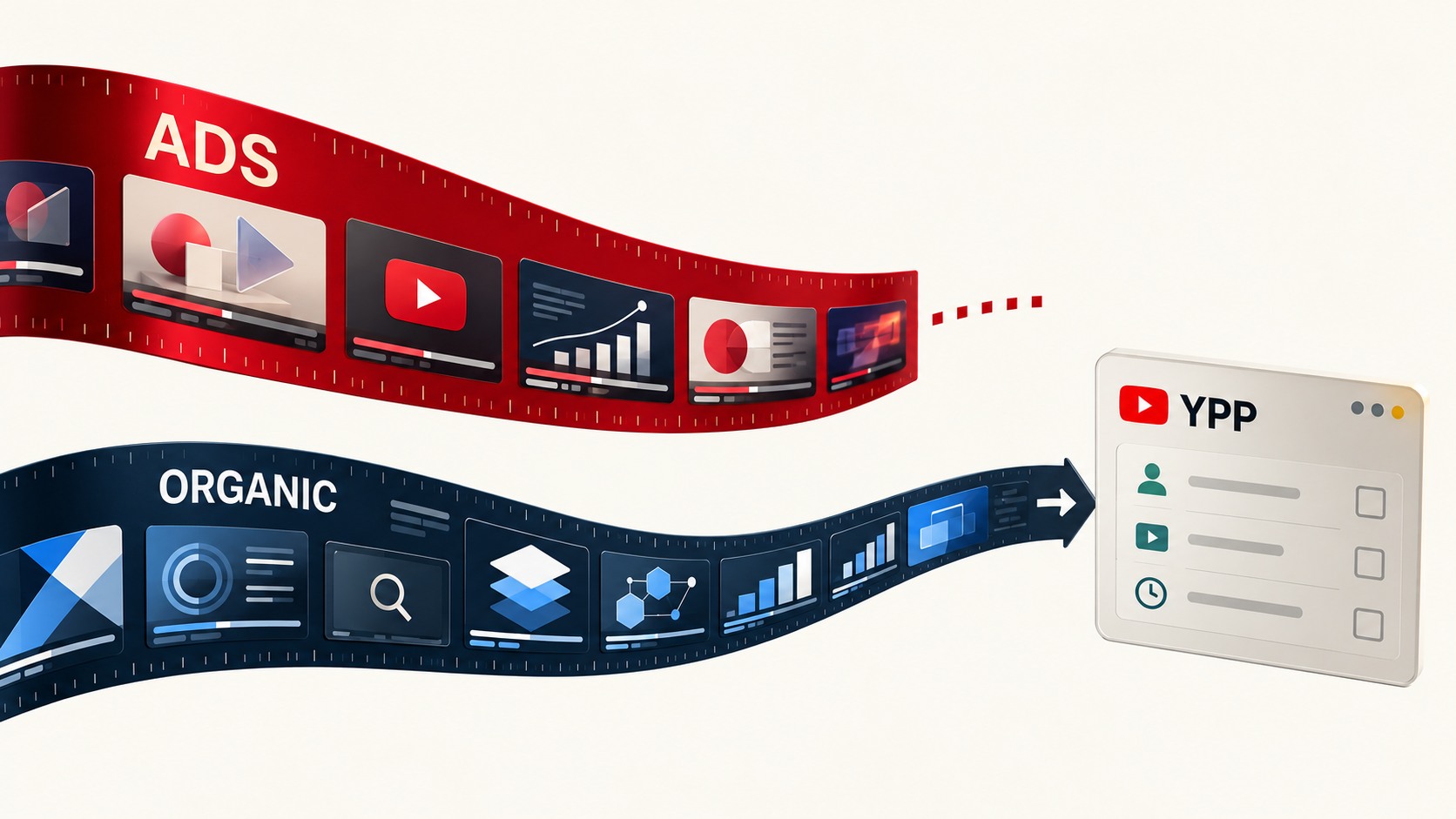
Does YouTube Promote count toward monetization? Watch hours and subscribers acquired through advertising do not count toward YouTube Partner Program eligibility. Later organic viewing is a separate event: YouTube says its Follow-on Views metric, available for Audience Growth promotions, can count toward YPP. That distinction matters before you spend. YouTube Promote FAQ
A campaign can introduce your channel to people without buying your way into monetization. To judge it fairly, keep three records separate: the advertising results, what viewers subsequently choose to watch, and the eligibility progress YouTube actually reports.
Start with the outcome you need
“I want more views” leaves too much unspecified. Are you trying to find an audience for a cooking series, sell a course, or meet an eligibility threshold? Those require different evidence.
| Your main goal | Evidence worth collecting | Spending decision |
|---|---|---|
| Meet YPP requirements | Your channel’s current Earn report and applicable eligibility rules | Do not buy advertising on the assumption that paid watch hours or subscribers will fill the gap. |
| Introduce a series to relevant viewers | Campaign targeting, costs, and what viewers choose to watch afterward | Consider a discovery test with a fixed budget and a specific audience in mind. |
| Generate website enquiries | Recorded website actions and their business relevance | Assess the action and its cost, not the public view counter. |
| Make a video look popular | A visible count, with no evidence of interest | Reconsider whether this solves a real business problem. |
| Improve organic recommendations directly | A promise that advertising will “train the algorithm” | Do not accept that promise as the reason to spend. |
Use the table to decide what to measure before setting a budget. A campaign can still fall short of its goal.
Keep these three ledgers separate

Text version of this diagram
Ad-acquired watch hours and subscribers do not count toward YPP eligibility. Organic Follow-on Views are available for Audience Growth promotions and can count. Use the Earn report for actual qualifying totals and channel status. Meeting an eligibility threshold is not an acceptance guarantee.
1. Advertising results
Record the campaign, promoted video, objective, dates, spend and exact metric names. Save any targeting settings that matter to your goal. A report labelled “views” needs its own definition; do not silently rename it “new viewers,” “qualified views” or “watch hours.”
Promote is YouTube’s simplified advertising product, powered by Google Ads. That does not mean every service marketed as “YouTube promotion” uses it. YouTube Promote FAQ
2. Later organic activity
Follow-on Views describe videos watched organically after someone encounters promoted content. They are not a relabelling of the original ad event, and the metric is specific to Audience Growth promotions. YouTube Promote FAQ
Record that metric as reported, where available. Do not reconstruct it by subtracting campaign views from your public counter. Those totals may have different definitions and reporting periods.
3. YPP eligibility progress
Use the Earn area of YouTube Studio to check your channel’s eligibility and application status. YouTube’s eligibility guidance excludes ad campaigns from qualifying watch hours and Shorts views. Meeting a threshold also does not guarantee acceptance: the channel is reviewed against monetization policies. YPP overview and eligibility
An eligible viewing event and admission to YPP are different questions. Keep both visible in your decision.
A fictional campaign, without invented returns
Imagine a tutorial creator runs an Audience Growth campaign. The following figures are entirely illustrative, not SMMViva results or a prediction.
| Record | Fictional observation | What it establishes |
|---|---|---|
| Campaign report | $80 spent; 4,000 reported campaign views; 60 campaign-acquired subscribers | What the advertising report attributes to the campaign. |
| Follow-on Views | 240 reported organic follow-on views | A separate measure of subsequent viewing. |
| Earn report | The creator has not yet recorded a matched before-and-after snapshot | The eligibility change is unknown. |
The creator should not add 4,000 and 240 and call the result “4,240 monetization views.” Nor should they convert the 240 follow-on views into watch hours using the average duration of the promoted video. The viewers may have watched different videos for different lengths of time.
Save the relevant Earn report with its date and metric labels. Even if the figures later rise, the report alone cannot show how much came from this campaign rather than other channel activity. These observations are not enough to judge profitability.
Public views are another separate number
YouTube changed public view counting across formats from August 24, 2026, to count from the first frame. It describes an engaged view as a click to watch or viewing beyond the initial seconds. Its explanation says the change did not alter recommendations or YPP requirements. YouTube’s engaged-views explanation
That makes an older screenshot especially poor evidence for a newer campaign unless the metric definitions match. Keep the metric label and capture date alongside each number. Do not apply a universal “30 seconds equals an organic view” rule or assume a public-count increase is a matching increase in qualifying activity.
Will Promote improve organic recommendations?
YouTube says ad performance does not determine how its typical organic search and discovery systems recommend content. YouTube Promote FAQ
A person who discovers your channel through an ad might later choose to watch again. That possibility is useful to measure, but it is not an algorithm guarantee. Avoid both extremes: “advertising buys organic ranking” and “no later activity from an ad-discovered viewer can ever matter.”
A more practical question is whether you have a clear next video for the intended audience. If a promoted beginner lesson leads to an unrelated channel, more exposure may not answer the viewer’s next question. Make that next step clear before paying for promotion.
Questions to ask any promotion provider
Before comparing prices, request a written explanation of:
- Delivery method: Which platform or distribution method will generate the activity?
- Target and objective: Which video or channel is involved, and what outcome is being purchased?
- Measurement: What exact event is reported, in which system and over which dates?
- Audience evidence: How is any geographic, language or interest claim supported?
- Costs and limits: What is the spending ceiling, and what charges are additional?
- Remedies: What happens if delivery is partial or materially different from the description?
A public-count screenshot does not answer all six. Neither does a label such as “real,” “premium” or “monetization ready.”
YouTube prohibits artificial metric inflation and warns that violations by a hired promoter can affect the channel. Outsourcing does not transfer that responsibility away from you. YouTube fake-engagement policy
For an offer you are considering, compare the delivery-method explanation with its service limitations and refund terms. If the method is unclear or incompatible with platform rules, decline rather than treating a refill as protection.
A final decision before you pay
Write one sentence: “I am spending up to ___ to test whether ___, measured by ___ over ___.”
If the blank is “buy the remaining YPP eligibility,” stop. If it describes a relevant discovery or business-action test, check the method, reporting and budget. Use the YouTube services overview only to compare documented options, not as evidence that every listed metric serves the same goal.
The useful purchase is one whose outcome you can define and verify. When the goal and deliverable do not match, choosing not to buy is the better result.
Sources
Official documentation checked October 28, 2026: YouTube’s Promote FAQ, YPP eligibility guidance, engaged-views explanation and fake-engagement policy. Recheck current requirements before a spending decision.