TikTok Qualified Views vs Total Views: An Evidence-Based Checklist
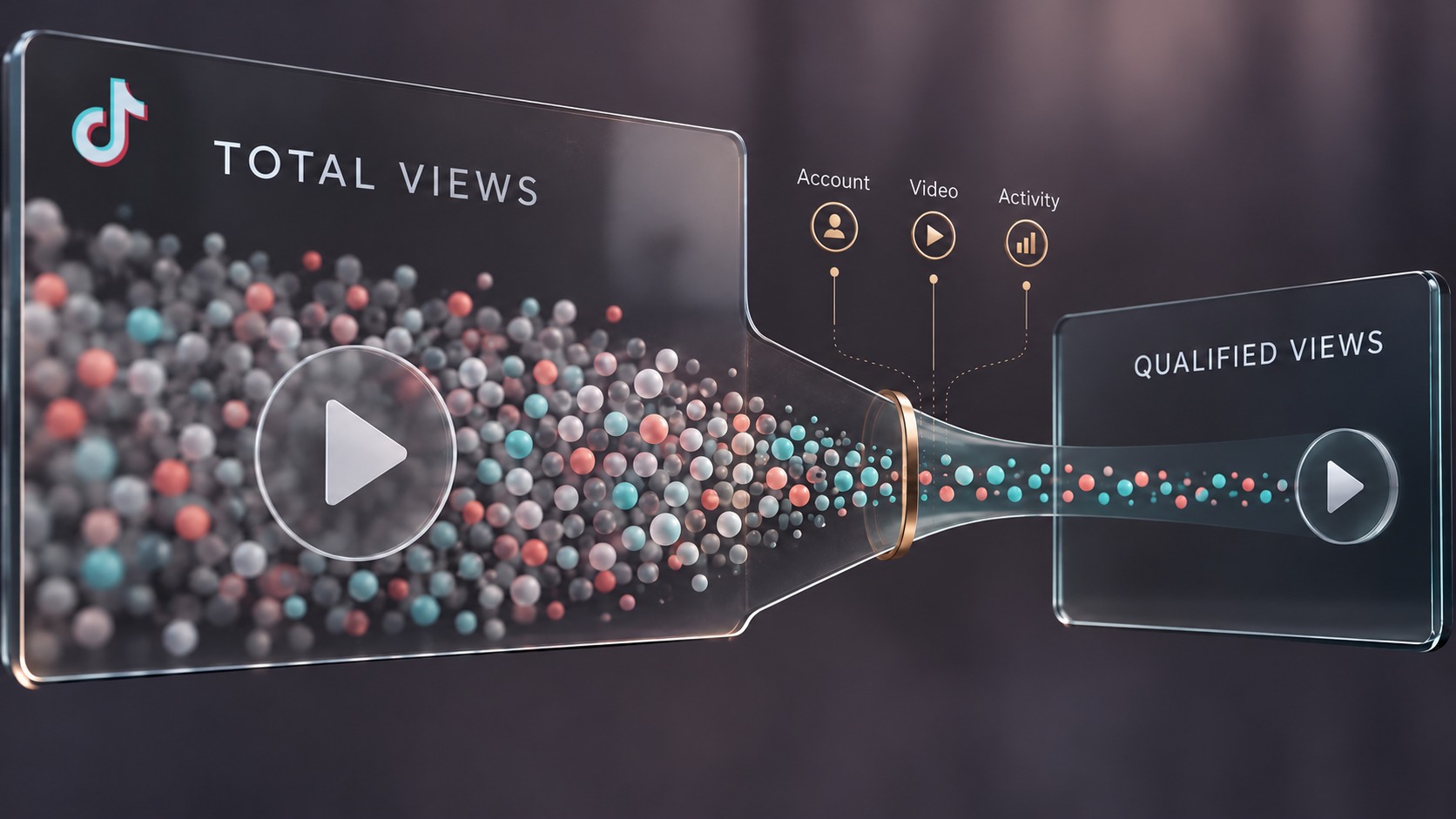
TikTok qualified views can be lower than total views because a public counter and a rewards-program metric answer different questions. The public number alone cannot tell you which activity qualifies for rewards, whether a video is eligible, or how much you will earn.
Start by checking that you are comparing the same video, program and reporting period, then look at its status information. This checklist helps you collect that evidence without guessing a cause from a percentage or buying more views to fill an unexplained gap.
Start with the program, not the public counter
Write down the exact monetization program shown in your account. Do not mix Creator Rewards information with instructions for a different TikTok earning product.
TikTok’s official Creator Rewards announcement describes separate reporting for qualified views, estimated rewards and program eligibility. These are related, but they are not interchangeable measures. The announcement is from 2024, so it provides context rather than a complete statement of today’s regional requirements. TikTok’s Creator Rewards announcement
For your account, record:
- Program name and account region.
- Whether the account is enrolled, applying or showing another status.
- The video identifier and publication date.
- The date range and timestamp of each report.
- Any eligibility, processing or exclusion explanation displayed for that video.
Use the program information available in your account and current official terms for the applicable region. A rule copied from another creator’s screenshot may concern a different country, program or period.
Separate three questions
Is the account eligible for the program?
Account access is a different question from how a particular video performed. If your account does not have the relevant program report, do not interpret an absent qualified-view field as zero. First establish which program, if any, applies.
Is this particular video eligible?
Record the video’s displayed status and any explanation. Preserve the exact wording rather than translating every issue into “not enough views.” Where a review or appeal route is offered, the reason shown should guide the information you provide.
Which viewing activity is credited?
Once the account and video context are clear, inspect the qualified-view measure and any available breakdown. Do not assume every view of an eligible video must qualify, or that a low credited number proves the video itself was rejected.
That order prevents wasted work. Increasing a public counter does not resolve an account-access problem or explain a content-eligibility decision.
Check the scope before calculating a ratio
Place the two reports side by side and answer:
- Are they for the same video, not a repost or a similar upload?
- Does one show lifetime activity while the other covers selected dates?
- Were they recorded at comparable times?
- Do the reports identify different traffic sources or paid activity?
- Is either report incomplete or awaiting an update according to an official notice?
If the scopes differ, record the mismatch first. A precise calculation using incompatible numbers gives a misleading impression of certainty.
You can calculate reported qualified views ÷ reported total views × 100 once you have checked which video, period and activity each figure covers. Treat the result as a descriptive ratio for that evidence, not a universal quality score. A different creator’s ratio is not a required target.
A fictional evidence pack
The following record is invented to show how to organize an investigation. It is not a real creator’s dashboard, an earnings example or a statement about TikTok’s current interface.
| Field | Fictional record |
|---|---|
| Program | Creator Rewards, as shown in the account |
| Account region | Recorded privately by the creator; current regional terms not yet saved |
| Video reference | Example video A, published October 1 |
| Public total | 12,000, captured October 8 at 12:00 UTC |
| Program figure | 2,400 qualified views, captured at the same time |
| Report period | Program date filter not yet recorded |
| Video status | No status explanation was saved with the screenshot |
| Paid activity | A promotion ran October 3–4; campaign report available separately |
| Traffic-source breakdown | Not captured |
| Main unresolved question | Are the two figures comparable, and what does the applicable program report exclude? |
The arithmetic is 2,400 ÷ 12,000 = 20%. But it would be premature to call the remaining 9,600 “disqualified viewers.” The evidence lacks a matched date range and an exclusion breakdown; it does not even establish that both counters describe unique people.
The next action is to save the missing program filters, status information and current regional rule. Buying another package of views would increase the uncertainty rather than answer the question.
Copy this blank record for your own video
Video URL or ID: ___
Program and account region: ___
Account enrolment/status and relevant date: ___
Upload date and video duration: ___
Public metric, value and capture time: ___
Program metric, value, date filter and capture time:
___
Video status and exact reason, if shown: ___
Traffic-source information available: ___
Paid, promoted or sponsored activity and dates:
___
Content/originality concern, if identified by the
platform: ___
Official rule URL, regional scope and checked date:
___
Question the available evidence cannot answer: ___
Keep sensitive account information private. A support request needs relevant evidence, not passwords, login codes or unrelated personal data.
Keep paid activity separate
A promotion report records advertising activity under its own measurement rules. It does not show whether those events qualify for creator rewards. Similarly, a provider’s promise to deliver “TikTok views” is not evidence of rewards-program credit.
Record paid activity separately and check how the current rules for your program treat it. Do not budget on the assumption that purchased or promoted traffic will earn its cost back. If a seller guarantees qualified views, revenue or monetization approval without verifiable platform evidence, do not rely on that claim.
Before considering a service, compare its delivery-source explanation with the TikTok service limitations. More paid exposure and more eligible organic viewing are different objectives, and this guide does not verify that any service can deliver reward-eligible organic views.
Handle Search and regional claims carefully
A mention of Search in a program explanation does not, by itself, define which Search views qualify. TikTok’s 2024 announcement discussed “search value” as a rewards-formula factor; that statement should not be converted into an unsupported current traffic-source eligibility rule. TikTok’s program explanation
For a disputed rule, save the official page, publication or update date, program name and regional scope. If official sources appear inconsistent, ask support which rule applies to the account and reporting dates in question. Do not select whichever wording produces the most attractive earnings forecast.
This checklist deliberately does not supply a country list, Search threshold or fixed reporting delay. Those details need current, applicable primary confirmation.
Choose the next action from the evidence
| What you have established | Appropriate next step |
|---|---|
| Different dates, videos or metric scopes | Correct the comparison before diagnosing the gap. |
| A documented processing window has not elapsed | Recheck after that documented window; preserve the original timestamp. |
| A specific eligibility or exclusion reason is shown | Read that reason and the applicable rule; use any available review process if warranted. |
| Comparable reports, no explanation and a persistent discrepancy | Send a concise evidence pack through the official support route available to you. |
| Credited organic viewing is weaker across comparable eligible videos | Test one content variable and measure the next comparable batch. |
For a content test, change one useful element, such as whether the opening makes the video’s topic clear. Do not infer a precise count of short viewing sessions from average watch time alone. An average cannot reveal the whole distribution.
Use the evidence to choose between a content test, a corrected comparison or a support question.
Sources
TikTok’s Creator Rewards announcement was checked October 28, 2026. Consult the current Creator Rewards support page and Creator Academy qualified-view guidance for applicable rules. Their detailed current text was not independently accessible during this check; no unverified regional thresholds are stated here.