
Refill vs Non-Drop vs Refund: What Your SMM Order Terms Mean
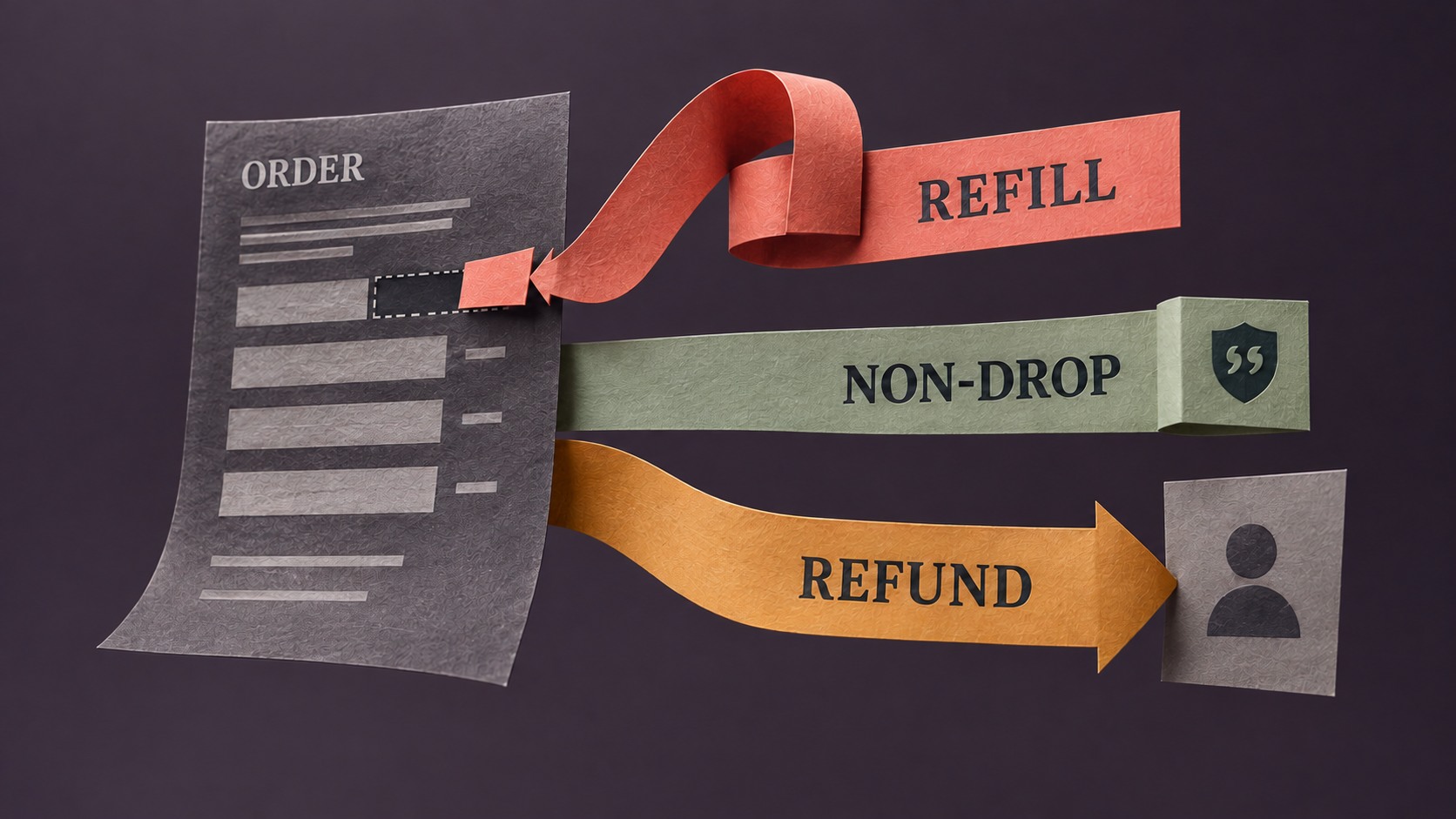
Refill describes a possible remedy after a drop. Non-drop describes a retention claim. Refund concerns the return of money or account credit. Treating these as interchangeable can leave you expecting a remedy that the offer never included.
Check what the seller has agreed to do, the conditions that apply and how to make a request. This guide explains how to read those terms, record the evidence and choose a sensible next step when an order does not match expectations.
What is the difference between refill, non-drop and refund?
These are reading distinctions, not a universal industry contract. The exact offer and applicable terms determine the commitment.

Text version of this diagram
Refill: check which losses qualify, the coverage period and request process. Non-drop: check what retention is claimed and how it is defined; it does not itself include refill or refund. Refund: check amount, conditions and destination; wallet credit is different from payment-method reimbursement.
| Term | What to establish | What the term alone does not establish |
|---|---|---|
| Refill | Whether eligible losses after delivery can be replaced, and under what conditions | Permanent retention, automatic replacement, cash reimbursement or unlimited claims |
| Non-drop | What retention behavior the seller is claiming and how that claim is defined | An included refill, a refund entitlement or proof that losses cannot occur |
| Refund | Which amount may be returned, why, and to which destination | Return to your original payment method, withdrawal of wallet funds or reimbursement of fees |
A service can carry a Non-drop claim without a stated refill remedy. A different service can offer a refill without claiming that losses will never happen. A refund may concern an undelivered quantity rather than a later reduction. Read each separately.
The same caution applies to a broad word such as “guarantee.” Ask what is guaranteed: delivery, replacement after a drop, a review of the order, or a financial remedy. Do not translate it into Refill unless the terms actually describe post-drop compensation.
Decode the offer without filling in missing terms
Consider this fictional feature excerpt, used only to illustrate formatting:
Refill: 30 days
That line gives a stated duration. It does not tell you when the clock starts, which losses qualify, how many requests are allowed or what happens if a refill cannot be completed. Those details still need written confirmation. This is not a SMMViva service specification.
Likewise, do not infer a complete policy from abbreviations such as R30 or promotional phrases such as “lifetime.” Ask the seller to define the label. Lifetime needs a defined scope; a number needs a start point and an end point.
Save answers to these questions before paying:
- Coverage: Which service and order types qualify? Does the remedy concern delivered units that later disappear?
- Clock: What event starts coverage, and what exact date and time does it end? Which timezone applies?
- Measurement: What baseline, count or evidence determines an eligible loss?
- Threshold and cap: Is there a minimum qualifying loss or maximum replacement quantity?
- Exclusions: Could a changed target, overlapping orders, removed content or other conditions affect a claim?
- Process: Is a request required? Which official account page or support route accepts it?
- Limits: Are there limits on requests, or a waiting period before another request?
- Fallback: If replacement cannot be delivered, is another remedy available, and where would any refund go?
An unanswered question stays unanswered. Do not replace it with a rule borrowed from another panel.
A decision tree for an order that looks wrong
1. Has the order finished delivering?
Check the status and its definition. A smaller-than-expected count while delivery is still in progress is not automatically a post-delivery drop.
If delivery is within the offer’s documented timing, follow those instructions. If a stated deadline has passed, or the status is unclear, ask for a status review. Do not invent a standard waiting period.
For a partial or cancelled order, check the specific undelivered-quantity and cancellation terms. A refill process may be the wrong route.
2. Does this exact order include a refill?
Use the saved service description, order record and applicable policy. A Non-drop label elsewhere in the catalogue does not answer the question for your order.
If a refill is explicitly included, continue to eligibility. If it is explicitly excluded, review any separate remedy. If the wording is missing or contradictory, ask support before treating the claim as valid or invalid.
3. Does your request meet the conditions?
Check the coverage dates, baseline, threshold, exclusions and claim limit. Keep a record of what you can demonstrate and what you cannot.
If an important condition is unclear, ask about it before submitting a guessed calculation. If your request appears to qualify, use the documented review process and save the confirmation.
4. Is there a separate refund or cancellation question?
Requesting a refill does not automatically qualify you for a refund. Ask whether the relevant terms provide reimbursement, which amount is covered, and whether it returns to the payment method or becomes account credit. If no remedy is stated, request clarification rather than assuming one exists.
Worked example: a lower count is evidence, not attribution
Everything in this example is fictional. It illustrates a support decision, not a service promise.
| Observation | Recorded value |
|---|---|
| Channel subscribers before the order | 2,000 |
| Ordered quantity | 500 |
| Recorded count at completion | 2,500 |
| Recorded count at a later check | 2,420 |
The visible count fell by 80 between the last two observations: 2,500 − 2,420 = 80. That is a net change. It does not identify which accounts left or establish that 80 units from this particular order are eligible for replacement. Other joins and departures may have occurred between checks.
Suppose the saved offer includes “Refill: 30 days,” but the saved page does not define the start event or measurement baseline. You cannot determine eligibility just by counting days from payment.
Send the order ID, timestamps, saved terms and observed counts, then ask which baseline and coverage dates apply. If the seller confirms eligibility under the relevant terms, follow its claim process. If the problem is incomplete delivery instead, ask for a delivery review. If a refund is proposed, confirm its amount and destination before accepting the description as cash reimbursement.
What to include in a support request
A clear request helps separate facts from assumptions:
- The order ID and selected service.
- The original target, shared only through the provider’s appropriate private support channel.
- Order, completion and observation timestamps, with timezone.
- The status shown and counts recorded at each checkpoint.
- A saved copy of the relevant offer and policy wording.
- Relevant changes to the target or other orders, if any.
- The specific question: status review, refill eligibility, cancellation review or refund destination.
Keep screenshots focused. Redact passwords, login codes, payment details and unrelated private conversations. Avoid repeatedly placing another order to “correct” the count while the first order’s outcome remains unclear; that makes the evidence harder to interpret and can create additional charges.
What these terms cannot tell you
A replacement remedy does not demonstrate genuine reader interest, future sales or platform approval. A stable counter does not prove that the people behind it want your content.
Platform rules still matter. For example, YouTube prohibits artificial increases in engagement metrics and says a hired promoter’s methods can affect the channel. Telegram prohibits spam and warns about unwanted additions to groups and channels. A seller’s terms do not override either platform’s rules. YouTube fake engagement policy, Telegram Spam FAQ.
If your goal is an interested audience, consider useful content, permission-based promotion or native advertising rather than treating a replacement policy as evidence of marketing value.
Before you choose an offer
Keep the saved specification, the policy that applied when you ordered and any written clarification together. That record is more useful than a reassuring label on its own.
When considering a SMMViva offer, check its specific service details and refill and refund terms. If an important condition is not stated, resolve it before ordering. For the separate question of money paid versus unused account credit, see the Telegram order-cost guide.
Sources and review date
Platform-policy references checked on 28 October 2026: YouTube fake engagement policy and Telegram Spam FAQ. Offer examples are fictional. Provider-specific rights, periods and remedies must be established from the actual order terms.