
Facebook Page Likes vs Followers: Choose the Right Goal and Metric
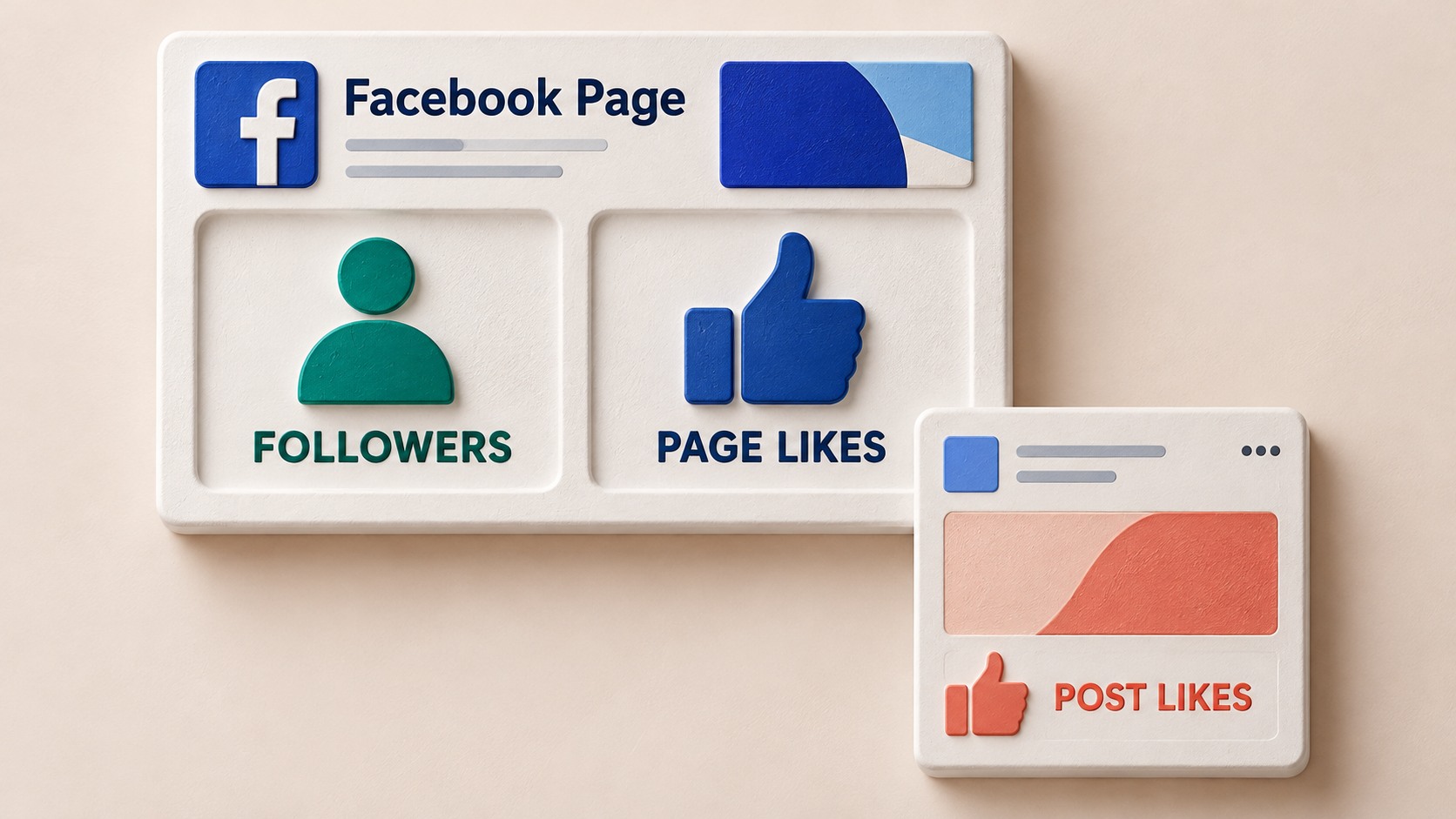
Facebook Page likes, Page followers and likes on a post refer to different things. Before comparing services or deciding which number to grow, identify the object on your screen and the outcome your business needs.
For an ongoing Page audience, follower activity is more relevant than reactions to one post. For enquiries or sales, neither counter is enough on its own. A larger number does not guarantee that more people will see your next update or become customers.
Identify the object before the counter
Start with the URL and the surrounding content, not the word “likes” in an offer title.
| What you are looking at | What the counter refers to | What it does not establish |
|---|---|---|
| A Facebook Page header | Page-level followers, or a Page-like measure if shown | How many people saw a specific post or want to buy. |
| A personal or professional profile | That profile’s audience or connections | Followers of a separate business Page. |
| An individual post | Reactions to that post | Page follows or recurring interest in future updates. |
| A Reel or video | The particular content’s displayed metrics | A matching change in the Page’s follower total. |
| An analytics or advertising report | The metric defined in that report | Automatic equivalence with a public-facing counter. |
A business name does not prove that the destination is a Page. Likewise, a link containing a video does not tell you whether a seller intends to change views, reactions or followers. Ask for the exact target and metric.
A simple “identify this counter” card
The following is a conceptual illustration, not a Facebook screenshot or a representation of the current interface:
BUSINESS PAGE HEADER
Example Bicycle Workshop
1,200 followers  <- A: audience connection to this Page

INDIVIDUAL POST
Saturday repair clinic
85 reactions     <- B: responses to this particular post

BUSINESS RECORD
3 repair enquiries <- C: an outcome recorded by the business
The follower count, post reactions and repair enquiries answer different questions. More reactions do not show that the Page gained followers, and neither counter proves that it generated enquiries. Keep all three separate when comparing an offer with your goal.
Why does a Page show Follow rather than Like?
Meta announced a shift from Page likes toward followers in its 2021 New Pages Experience. The announcement described followers as people who can receive Page updates. That explains the direction of the product change, but a historical announcement is not a map of every current screen. Meta’s New Pages Experience announcement
Use the actual labels visible on the Page you manage. If an offer promises “Page likes” while your Page shows a follower count, ask which event it delivers and where that result will be measured. Do not assume the seller is using the terms precisely, or that an older service description matches your Page’s current experience.
You do not need to restore a missing historical counter merely because a package is named after it. First establish whether the package corresponds to an available, useful measure at all.
Match the metric to the goal
Deciding “likes or followers?” is easier once you finish this sentence: “We want Facebook activity to help us ___.”
| Your actual goal | More useful evidence | A poor substitute |
|---|---|---|
| Build an interested recurring audience | Relevant follows plus subsequent engagement with your work | A follower total with no information about interest. |
| Assess one announcement | The post’s distribution and meaningful responses | Page-wide likes collected at another time. |
| Get local enquiries | Relevant messages, calls or booking requests recorded over a defined period | Global follower growth. |
| Send people to a website | Clicks and the actions those visitors complete | Reactions with no observed website activity. |
| Evaluate advertising | The campaign’s chosen outcome, costs and business quality | Assuming a larger Page count improves every ad. |
| Document a visible counter | The exact object, metric, baseline and reporting method | A screenshot of a different Page or post. |
Pick one primary outcome and a small number of supporting observations. A local workshop might track completed bookings first, enquiries second and relevant content engagement as context. It does not need five counters all labelled “success.”
A fictional business with followers but no enquiries
Imagine a bicycle repair shop with 6,000 Page followers. Over a month, it records no repair enquiries from Facebook. Its owner considers a package promising another 2,000 followers.
These numbers are invented, and they do not explain the cause. The existing audience could be outside the service area, the posts could lack a clear booking option, or enquiries might be arriving without being attributed to Facebook.
Before increasing the counter, the owner can check four things:
- Offer clarity: Do recent posts explain the repairs available, location and how to book?
- Audience relevance: Does available audience information match the area the shop can serve?
- Action path: Can a person actually reach the shop through its chosen contact route?
- Measurement: Are staff recording where enquiries came from, consistently and without collecting unnecessary personal information?
A useful next test is one clearly described repair offer with a working enquiry route and a fixed observation period. Keep other major changes limited so the result is easier to interpret.
The point is that another follower package would not, by itself, answer any of the four unresolved questions. “None of these counters solves the problem yet” is a valid buying decision.
Check the delivery method, not just the package name
A public number does not reveal how the activity was generated. Ask whether an offer uses native advertising, another disclosed distribution method, or artificial engagement. A supplier’s word “real” is not evidence that people voluntarily care about the business.
Meta has described enforcement against coordinated fake engagement and fake Pages used to inflate reach, including scripted follows. That is an important risk to consider when checking a delivery method. Meta’s spam-enforcement update
“No password required,” gradual delivery and a refill promise do not establish platform approval. Nor does a refill establish that replacement accounts are interested potential customers. If a seller cannot explain the method or promises guaranteed reach and sales from a counter increase, do not treat the uncertainty as a minor detail.
Compare any relevant Facebook service description with the delivery-method and limitations information. This comparison should be able to end in a decision not to order.
Save this pre-purchase check
Complete these fields before submitting a link or paying:
- Object: Page, profile, post or Reel: ___
- Exact target URL: ___
- Metric promised, using the seller’s wording: ___
- Metric visible or measurable on that target: ___
- Business goal: ___
- Delivery method and evidence: ___
- Audience claim and how it is supported: ___
- Reporting dates, baseline and exclusions: ___
- Price, additional charges and applicable remedy: ___
- Unresolved mismatch or question: ___
A before-and-after count can record movement without proving which activity caused it. If organic growth, advertising and another service overlap, preserve that fact in the record rather than assigning every new follower to one source.
If the object or metric remains ambiguous, use the service-definition and support FAQ before ordering. Do not send passwords or login codes to resolve a target-link question.
The practical answer
Choose a Page-level follower measure when your question concerns the Page’s ongoing audience. Choose a post-level measure when evaluating that post. Choose a business-outcome measure when the goal is enquiries or sales.
Then verify the method and evidence. The best metric is the one that helps you make the next decision, not necessarily the largest number on the screen.
Sources
Checked October 28, 2026: Meta’s 2021 New Pages Experience announcement and 2025 spam-enforcement update. The illustration and business example are fictional; current labels should be checked on the actual target.